There is a place north of Stung Treng where the Mekong does something extraordinary. For several months each year, the river rises so dramatically — sometimes eight to ten metres above its dry-season level — that the surrounding forest disappears entirely beneath the water. Trees stand submerged to their crowns. The ground vanishes. The jungle becomes a lake.
And then, if you take a longtail boat out into this submerged world at the right hour, everything goes quiet. The engine cuts. The boat drifts. All around you, dark trunks rise out of still, mirror-like water, their reflections doubling the forest below the surface. Kingfishers dart between branches. Fish break the surface in silver flashes. Somewhere above, an unseen bird calls once and falls silent.
This is the Mekong flooded forest. And it is unlike anything else in Southeast Asia.
What Are the Flooded Forests?
The flooded forests of Stung Treng are part of a vast wetland ecosystem that spans the northern stretch of the Mekong in Cambodia, extending toward the Laos border. They are classified as a Ramsar Wetland — a site of international importance — and they represent one of the last functioning examples of this kind of riverine forest ecosystem in the entire Mekong basin.
In the dry season, from roughly November to May, the water recedes and the forest floor re-emerges. The channels between islands narrow. Trees stand exposed on dry ground. You can walk through sections of forest that will be three metres underwater in six months' time.
In the wet season, from June to October, everything changes. The Mekong swells with rainfall from across the watershed. The river pushes outward into the forest, filling every depression, every channel, every gap between trees. What was jungle becomes open water. Navigation requires a guide who knows the channels — because landmarks disappear and distances expand in ways that disorient visitors completely.
"The jungle becomes a lake. And then, if you take a boat out into it, everything goes quiet."
What You Will See
The flooded forest is not a single thing — it is an ecosystem in constant motion, and what you encounter depends on the season, the time of day, and how far into the channels your guide takes you.
Birds are the most immediately visible inhabitants. Kingfishers are everywhere — the common kingfisher, the stork-billed kingfisher, and the black-capped kingfisher all frequent these waterways. Large water birds — herons, egrets, and cormorants — stand motionless in the shallows or take slow, heavy flight across the channels. If you are quiet and move slowly, you will also see river terns, bee-eaters perched in brilliant rows on dead branches, and the occasional osprey circling overhead.
Fish are the forest's invisible engine. The flooded forest is one of the most productive fish nurseries on the Mekong — juvenile fish shelter among the submerged roots and branches during the flood season, feeding on the organic material that washes in from the surrounding land. Local fishing families have worked these waters for generations, and watching a fisherman cast a net in the early morning light, surrounded by submerged trees, is one of the most quietly beautiful things you can witness here.
The Irrawaddy dolphins occasionally enter the flooded forest channels during high water. These rare freshwater dolphins — fewer than 100 remain in the Mekong — are more commonly seen in the open river sections, but sightings inside the forest do happen. Your guide will know which channels to try.
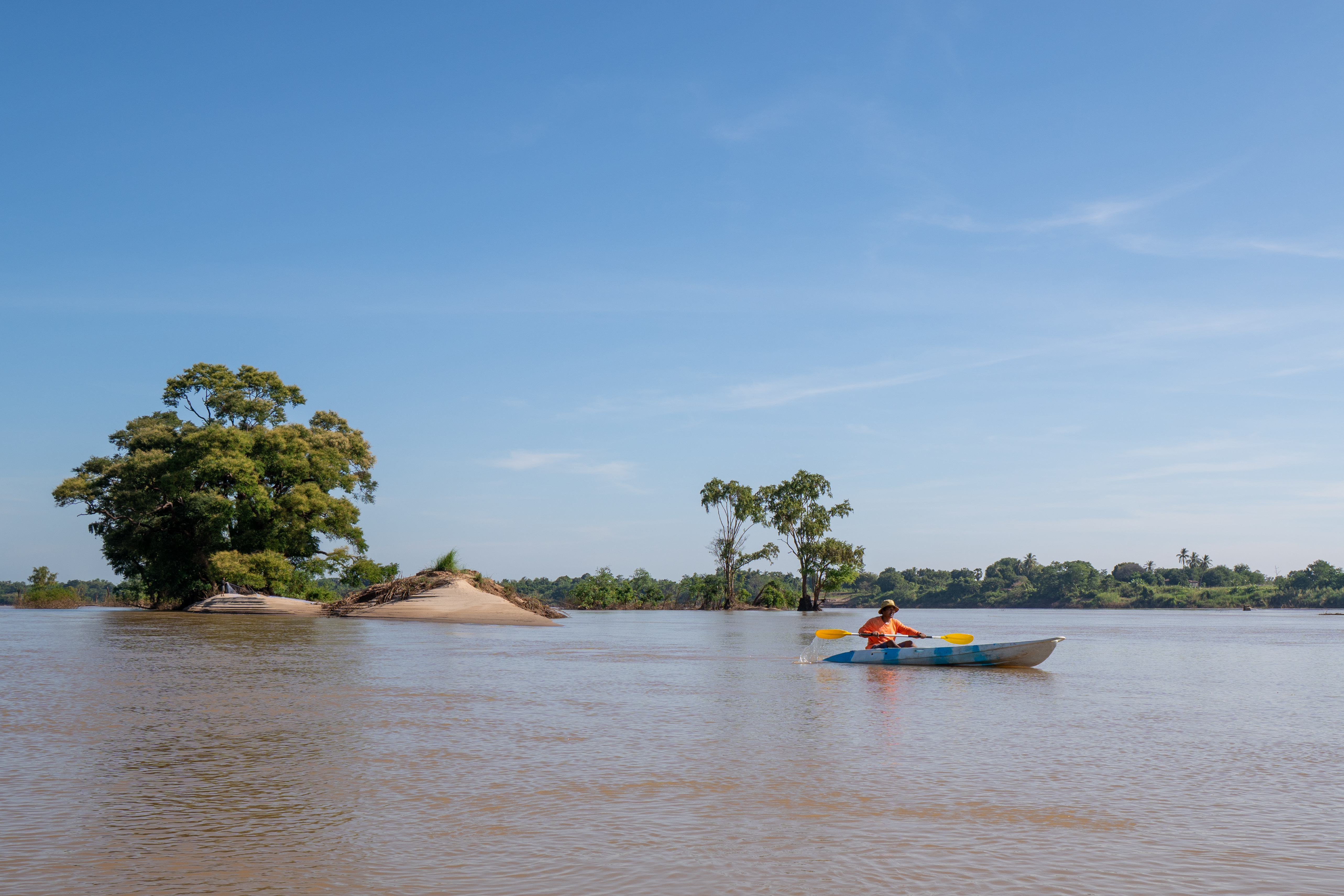
The flooded forest channels are best explored by kayak — the silence is complete once the engine cuts
Kayak vs Longtail Boat — Which is Better?
Both have their place, and the best experience combines them.
The longtail boat is how you cover distance — crossing the wider river channels, reaching the deeper sections of the forest, and travelling between islands. It is fast, and from the bow you get an unobstructed view of the landscape opening up around you. The sound of the engine bouncing off the water and trees is its own kind of music.
The kayak is how you go deep. In a kayak, you can enter channels too narrow for a motorboat — places where the trees press in on both sides and the canopy closes overhead. The silence is total. You move at the pace of the water. Animals that would flee from an engine stay put as a quiet paddle approaches. This is the closest you will get to the forest's interior life.
Our Kayaking & Boat Cruise tour uses both — the longtail to reach the forest and navigate the wider stretches, and kayaks for the narrow interior channels. If you have limited time and can only choose one, the kayak sections are the most memorable.
Wet Season vs Dry Season in the Forest
Season Comparison
- 🌧 Wet season (Jun–Oct): Forest fully flooded, most dramatic scenery, water level 8–10m higher, extraordinary sense of scale
- ☀️ Dry season (Nov–May): Channels narrow, forest floor visible, easier navigation, cooler temperatures
- 🐦 Birdlife: Present year-round, most diverse in the dry season transition months (Oct–Nov)
- 🚣 Kayaking: Best in wet season when channels are open and navigable deep into the forest
- 🐬 Dolphins: More likely in the main river channel; present year-round
Most travellers visit in the dry season, when Cambodia's weather is most comfortable. The forest is beautiful year-round — but if you have flexibility, consider visiting in September or October when the flood is at its peak and the landscape is at its most surreal. The heat is greater and the skies are cloudier, but the flooded forest in full flood is a genuinely once-in-a-lifetime sight.
How to Visit
The flooded forests are accessible only by boat from Stung Treng town, approximately 15 to 20 minutes upstream. They are not visible from the road and there is no public access — a local guide and a boat are essential. Attempting to navigate the channels without a guide is genuinely dangerous, particularly in the wet season when landmarks disappear and channels shift.
We run two tours that take you into the flooded forest: the Mekong Boat Cruise (half day, by longtail) and the Kayaking & Boat Cruise (half day, combining both). Both depart early morning for the best light and wildlife activity. Both are available year-round.